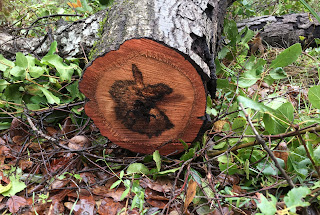
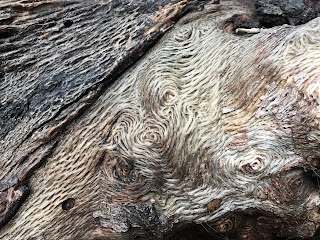
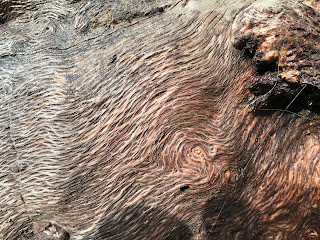
My last two projects used red alder and I thought I'd write a little about the wood and my experiences with it. I have a couple of books that talk about the most commonly used trees, but neither of them includes red alder.
Alder is a member of the birch family. One of 10 species of alder in America, red alder is the only one that grows large enough and in abundance to be commercially useful. It usually grows from 50-75 feet tall, occasionally reaching 100 feet.
 |
| Internet image: red alder tree |
Red alder is the most common and important of the hardwoods in the Pacific Northwest, making up to 60% of the hardwood volume there (not sure if that means volume of hardwood out in nature or in commercial use). It typically grows within 120 miles of the coast from central California up through coastal British Columbia and into southern Alaska. Nearer the coast, it grows on cool and moist slopes. When growing further inland, it is mostly near water drainages (water courses and wetlands).
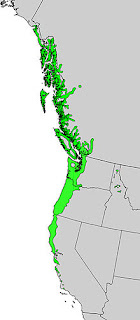 |
Image from Wikipedia:
Range of red alder in Pacific Northwest |
The bark is gray to whitish, and fairly smooth. With age, many white lichen spots grow on the bark, giving it a mottled look. Tufts of moss will also grow on the bark. The inner bark and wounds turn a red color when exposed to air, giving the tree its name.
 |
Red alder bark
(Image from nativeplantspnw.com) |
While on a hike recently I thought I might have come across red alder. But when I consulted my Pacific Coast Tree Finder pocket manual (reference below), it appears to have been white alder. Most of the references I've viewed say that the leaves of the red alder curl at the edges, but none that I saw on the hike or in internet pictures seem to show that.
 |
| My copy of Tom Watts' Pacific Coast Tree Finder pocket manual |
 |
| The page for red and white alder |
 |
| The leaf from my hike looks more like the white alder |
The tree is what is called a "pioneer" species. It colonizes quickly after soil disturbance - either from flooding, logging, fire, etc. It grows quickly, which it must, as it does not tolerate shade well. If lots of seeds germinate, those that grow more quickly will shade out and stunt or kill the smaller trees.
Stands of red alder trees will be found with a dense undergrowth of bushes and ferns. Its roots have nodules caused by a certain kind of bacteria that "fix" nitrogen in the soil, making it better for other plants to grow.
I read about many uses of red alder wood. It is low in pitch, making it good for smoking meat and fish. It is used for furniture, flooring, turning and carving. Lower grades of the wood are also used for pulp, plywood and chips.
 |
A small carving I recently did in red alder
(thanks to Mary May's YouTube video of same) |
 |
| The twin shoe shelves I finished a few weeks ago |
 |
| The coat rack recently completed |
The wood is diffuse porous with nicely consistent grain. I've attempted to take a photo of the end grain, but see Eric Meier's site (link below) for a far better picture at greater magnification.
 |
| End grain photographed through the 3X lens of my magnifying glasses |
I found the wood very nice to work with hand planes as well as saws and chisels. The end grain planed fairly easily, also. However, the plane soles and saw plates needed constant oiling. Otherwise, they would drag (more so than other woods I've used). My research found that the wood has little pitch (not sure if that means not resinous), but something in the wood made the tools drag when not oiled.
A few other details: although the wood is described as moderately hard, I found that it can dent fairly easily. Various sites say that there is little to no difference between heart wood and sap wood. But some of the boards I used had fairly clear differences. Not as stark as some woods, but the sap wood was definitely lighter. Red alder has poor rot resistance. I would not choose it for outdoor projects. It might last several years outdoors if not in contact with dirt, but I have no experience with it for such projects.
My projects have been finished in shellac, which resulted in a beautiful honey color and it should darken with time. I think the wood is quite attractive and will use it again if/when the chance comes. From what I've read, the world will be seeing more red alder in the future as it has become more popular for furniture.
Sources:
Pacific Coast Tree Finder, 2nd ed. by Tom Watts (pocket manual for identifying Pacific Coast trees)
https://www.wood-database.com/red-alder/ (Eric Meier's great site)
http://owic.oregonstate.edu/red-alder-alnus-rubra (info from a forestry products point of view)
https://www.naturallywood.com/species/red-alder/ (site promoting BC forest products)
https://en.wikipedia.org/wiki/Alnus_rubra (usual Wikipedia stuff - lots of good info)